

A real-hardware validation on Unibap’s iX10 showcasing that workflows can deploy and execute predictably in offline, flight-representative edge conditions without platform-specific adaptation.
Edge computing platforms impose a different set of constraints than cloud or ground-based systems, particularly around deployment, dependency management, offline operation, and observability. Validating software for these environments requires more than simulated benchmarks. It requires running real workflows on real, flight-representative hardware.
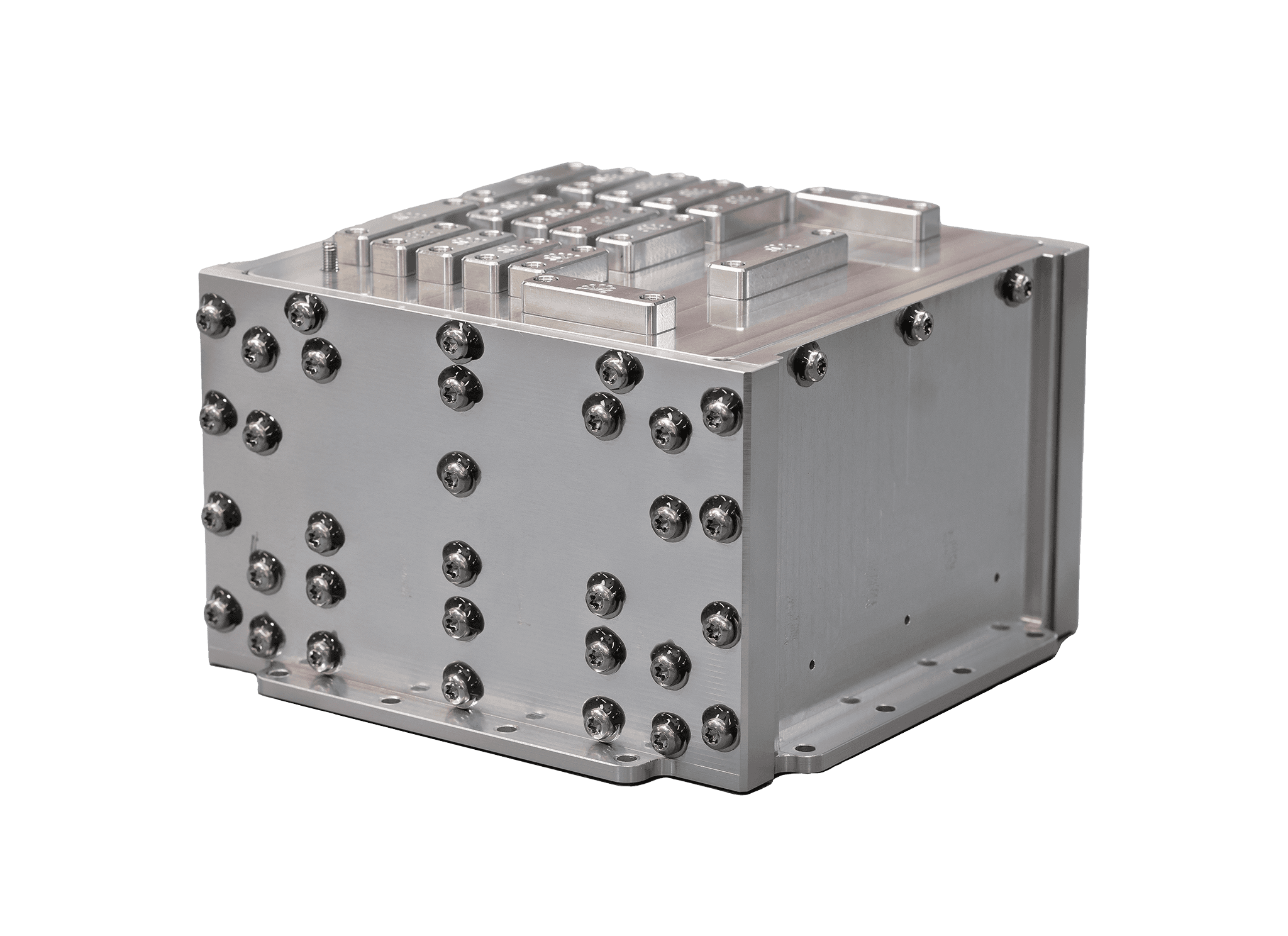
Unibap Space Solutions develops onboard computing systems designed for demanding space environments. Unibap’s iX10 is a radiation-tolerant onboard compute platform designed for high-performance processing in space environments.
Objective
The objective of this test was to validate execution of Tilebox’s workflow orchestration and runtime system on Unibap’s iX10 in a fully offline edge environment. The evaluation assessed orchestration correctness, object storage interaction, parallel execution behavior, and end-to-end observability under hardware constraints representative of flight-class edge compute systems.
The selected workflow was deployed without platform-specific modification and executed without external network dependencies in order to evaluate cross-environment consistency and operational predictability.
Configuration
Tilebox was granted SSH access to an iX10 engineering model and deployed a representative Earth observation workflow originally developed for a different environment. The workflow was executed end to end on Unibap’s hardware to assess deployment friction, runtime behavior, and system visibility without requiring platform-specific adaptation.
To verify the system, we executed a parallelized ship-detection workflow using the following components:
Source data: A Sentinel-2 granule (110 x 110 km) stored in an S3-compatible object store
Tilebox binary: Built in Go for Linux and executed immediately with no issues
Object storage: Operated without issues on the ix10
Orchestration: Managed by the Tilebox Workflows daemon, executing tasks across multiple runner processes
Observability: Distributed logs and traces produced for ingestion into an OpenTelemetry (OTEL) dashboard
All workflow execution occurred offline. No external package resolution or online service dependencies were required.
Results
The workflow executed successfully out of the box. During testing, a platform-specific issue related to timestamp handling within the orchestrator was identified and resolved, demonstrating the value of pre-integrating software with real hardware environments where edge-specific behavior surfaces quickly.
We processed one full 110 x 110 km granule by tiling the input into subtiles (approximately 17 x 17 km), running AI inference per subtile, and then writing annotated outputs with red bounding boxes around detected ships.
The full offline workflow completed in 3 minutes 27 seconds, using 5 concurrent processes, with a perfectly linear 5x speedup (17 min 8 s compute time → 3 min 27 wall time) on the ix10 CPU, with significant additional speed-up expected for GPU based solutions.
Findings
A few implementation details surfaced quickly, which is the point of an edge compatibility test:
Python environment: The system Python version (3.8) was insufficient for the workflow runners. We resolved this by using uv to create a modern Python environment cleanly without changing the base system state.
Inference execution path: Our standard compatibility inference task uses PyTorch and is typically backed by Nvidia GPUs. The iX10 configuration we tested uses an AMD device, so this run executed using CPU inference.
We also identified and resolved an issue related to timestamp handling in the orchestrator during earlier validation work. That fix is now incorporated, and the iX10 test confirmed expected behavior in the full workflow run.
Validation Outcomes
The test confirmed correct orchestration behavior, stable object storage access, linear parallel scaling, and consistent observability signal production on Unibap’s iX10 in a fully offline configuration. The orchestrator required only a minor adjustment to support different system timestamps, proving that the core system functions seamlessly without deep adaptation. This reinforces Tilebox’s ability to deploy, observe, and manage workloads across heterogeneous edge environments, ensuring readiness for all future missions on iX10 platform without future bespoke adaptation.
The results demonstrate compatibility with a broader class of space-ready edge compute platforms, supporting consistent execution across heterogeneous ground and orbital systems while preserving orchestration behavior and observability signals.
This compatibility run validates a few practical requirements for edge and on-orbit deployment:
Workflows can be orchestrated reliably on the target hardware in an offline environment
Object storage access and parallel execution behave as expected under constrained conditions
Distributed observability signals are produced consistently for OTEL-based ingestion and debugging
The system can surface environment gaps quickly and resolve them without mission-specific reengineering