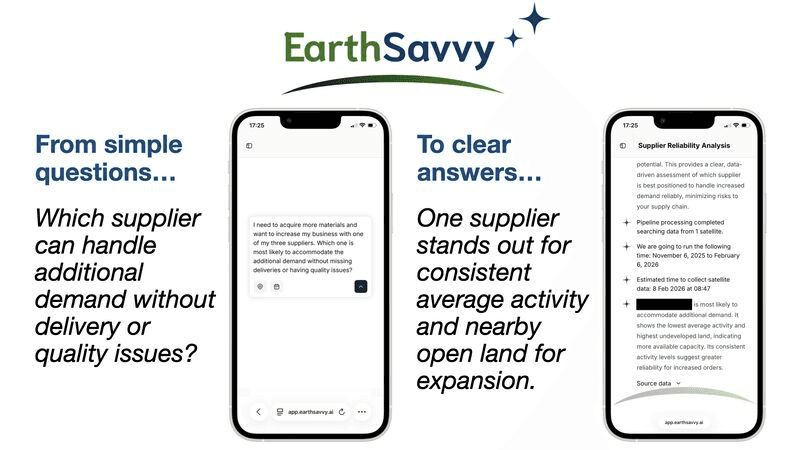

EarthSavvy's mission was to make EO satellite data more practical for the non-geospatial expert. The product allows users to ask natural language questions about the world around them, e.g. When is the best time to dock at the Port of Singapore to avoid high-traffic surcharges and idle time? In response, it delivers structured, repeatable insights instead of raw imagery requiring complex analysis.
From day one, EarthSavvy faced a hard constraint: building and maintaining satellite data infrastructure. This would have consumed its limited engineering time and delayed validation of its core product. Rather than treating data pipelines as a future optimization, EarthSavvy chose to solve this problem at inception by implementing Tilebox as its execution and orchestration layer.
This decision shaped EarthSavvy’s technical architecture, development velocity, and long-term roadmap.
Technical Architecture
Cloud: AWS primary, with selective use of Google Cloud
Frontend: TypeScript and React
Backend: Python APIs on AWS
AI Models: Google Gemini for language and custom models for physics-based analysis
Execution and orchestration: Tilebox workflows and runners
“Our biggest moment was realizing how fast we could adapt. We built the first prototype on Sentinel-2. When we needed thermal data, we added Landsat in hours. If we had built this ourselves with open source tools, that would have taken weeks. That was when it really clicked that this foundation let us focus on the problem we actually care about.”
Matt Evans
CEO and Co-Founder, EarthSavvy
Development Velocity: Scaling Up
While raw data volumes and compute throughput could be addressed with additional infrastructure, the real constraint at the earliest stage of scale was architectural complexity.
Specifically:
Managing metadata across multiple satellite constellations
Keeping historical and newly available data accessible through one system
Supporting new analytics without building constellation-specific pipelines
Scaling from a laptop prototype to clustered execution without rewriting core logic
Every incremental step in scale, from one job to hundreds per day, introduces failure modes if orchestration and data abstraction are not solved early. Tilebox unlocked pipeline resiliency and operational scale for EarthSavvy, including rapid growth from single digit daily jobs to a few hundred production jobs per day within months. Each job evolved to support multi-constellation satellite data discovery and download, AI-driven analysis, and results delivery to a customer-facing dashboard.
The Open Source Alternative
Prior to Tilebox, EarthSavvy explored open source Earth observation packages focused on Sentinel and Landsat data. These tools simplify access to individual datasets but stop short of providing:
Unified workflow orchestration
Consistent data representations across constellations
A scalable execution model
Ongoing metadata maintenance as new data becomes available
This approach would have required stitching together multiple packages, writing custom routers, and maintaining constellation-specific logic. The result would have been a brittle system where changes in one pipeline could cascade into failures elsewhere.
Why Building In-House Was Not Plan B
EarthSavvy deliberately chose not to spend its first year building infrastructure. The company’s goal was to reach users who did not already think in terms of satellites and imagery. Engineering time needed to be spent on:
Natural language interfaces
AI-driven interpretation and physics-based models
Customer-facing workflows
Validation of real-world demand
Without a stable and future-proof data foundation, EarthSavvy would have been forced to solve a different problem entirely. The opportunity cost would have been measured in lost time to market and delayed customer learning.
The Solution: A Framework, Not a Product
EarthSavvy adopted Tilebox as a developer framework rather than a fixed product. This allowed the team to implement proprietary logic while relying on Tilebox for execution, orchestration, and data abstraction.
Tilebox provided a consistent interface where satellite data is presented as structured arrays with associated metadata. Orbit, sensor type, and collection details remain available when needed, but do not dominate algorithm design.
This abstraction allowed EarthSavvy engineers to work on satellite data using techniques common in other data domains, without requiring deep expertise in every constellation format.
From Prototype to Production
12 Weeks - Initial prototype with Tilebox, built by a single developer (while managing other startup responsibilities)
<4 Weeks - Transition from a single-machine prototype to a scalable cluster execution MVP
Rapid Expansion of Data Sources
An early prototype relied solely on Sentinel-2 optical data. When a customer use case required thermal imagery, EarthSavvy added Landsat thermal data in a matter of hours.
The workflow followed the same pattern:
Discover data
Ingest metadata
Apply existing analytics
Deploy
With an open source approach, this expansion would have taken weeks and required new parsing, translation, and validation logic per data source.
Cost and Infrastructure Flexibility
Tilebox’s execution model allows EarthSavvy to bring algorithms to data rather than moving large datasets unnecessarily. This supports:
Multi-cloud execution
Cluster-based processing
A cost model that scales with usage rather than fixed infrastructure investment
It also avoids the long-term maintenance burden of custom pipeline code as constellations evolve.
Results
Engineering Outcomes
Prototype to production MVP in under four months total
Expansion from one satellite source to multiple constellations without pipeline rewrites
New data sources integrated in hours instead of weeks
Consistent execution model from development to clustered production runs
Developer Productivity
New engineers work against a unified data abstraction instead of constellation-specific formats
Algorithms can be developed without deep satellite domain knowledge
Manual pipeline maintenance is largely eliminated
Business Impact
Avoided an estimated 12 months of infrastructure development
Enabled early customer validation instead of internal platform building
Reduced technical risk for early investors by anchoring the product on proven execution infrastructure
Allowed engineering resources to focus on core differentiation rather than data plumbing
Provided immediate data integrity with traceability and execution consistency to satisfy customer requirements
Long-Term Roadmap: NRT Intelligence
EarthSavvy’s roadmap includes on-orbit processing, where analytics run before data ever reaches the ground. Tilebox’s ability to run the same execution framework across ground, cloud, and orbital environments makes this possible without redesigning the analytics layer.
For EarthSavvy, this means the same system can answer questions about historical imagery from years ago or near real-time observations captured minutes earlier.

About
EarthSavvy makes satellite data easy-to-use and delivers real insight, not raw images, to businesses, investors, and communities. EarthSavvy's AI engine turns natural-language questions into structured, automated analyses, providing on-going monitoring and near-real-time alerts for better decisions on supply chains, sustainability, infrastructure, and other aspects of our world.