

Every geospatial data pipeline needs the same foundational capabilities:
- A way to query metadata across multiple providers
- A workflow engine that handles parallel execution and resumes from failure
- Triggers that fire when new data lands
- Code that’s easy enough to write so you can iterate quickly
- As hyperspectral data adoption rises, a way to retrieve only the bands you actually need
None of these requirements are exotic. The problem is that no single tool has historically delivered all of them; teams build their stack by stitching together a STAC client, a PostGIS database, an Airflow or Temporal instance, custom storage retrieval scripts per provider, and homegrown deduplication logic on top.
That’s five tools, five sets of credentials, five places where things can break, and five ongoing maintenance burdens. Before a team writes a single line of the algorithm that actually differentiates their product, they’ve signed up to be a platform integrator.
The hidden costs of fragmentation
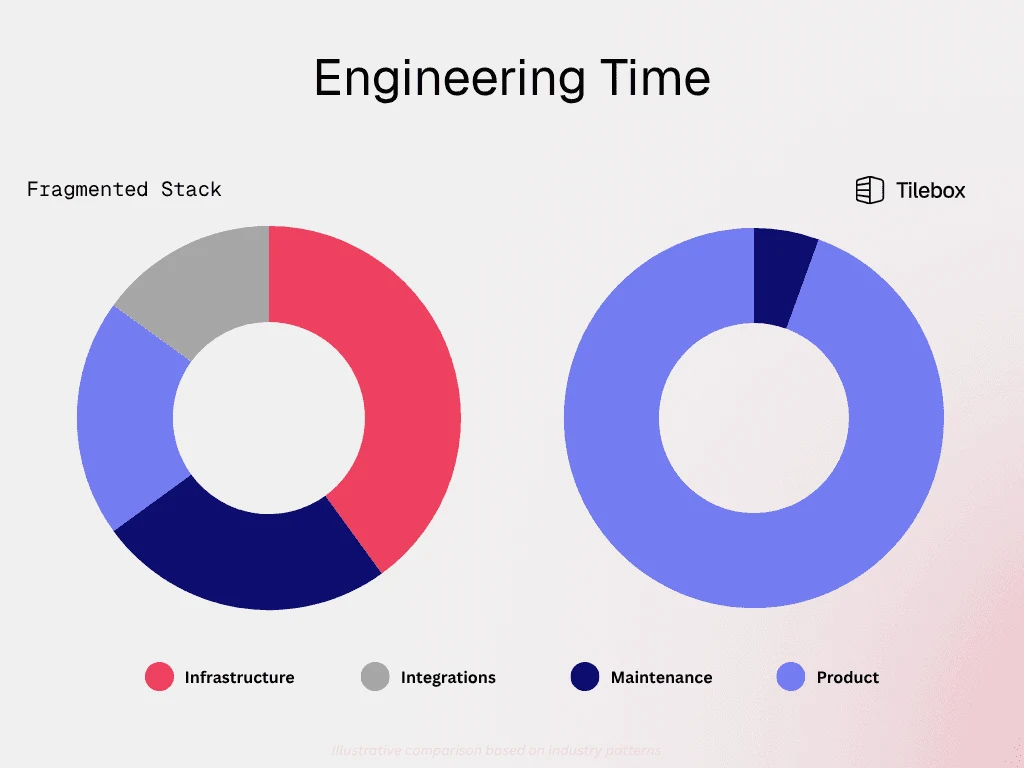
The compounding cost of this fragmented stack shows up in three places.
- Engineering time goes to integration work that no customer ever sees.
- New team members spend weeks learning a custom stack instead of a standard one.
- Every provider API change or breaking update means rewriting integration code your team never budgeted time for.
Every hour spent gluing tools together is an hour not spent on the algorithm, the user experience, or the customer. Teams under deadline pressure inevitably make trade-offs against infrastructure quality, and over time, those trade-offs compound into slower iteration, harder onboarding, and your competitive position becomes defined by what the team can maintain rather than what they could be building.
A different architecture
Tilebox combines those capabilities into a single framework. We created a developer experience that makes building faster with an execution architecture that makes running pipelines more cost-efficient and more reliable.
- Spatio-temporal metadata querying across open data and proprietary datasets through one API
- Storage clients that retrieve files directly from provider infrastructure with partial product downloads built in
- A workflow engine with automatic parallelization, retries, and idempotency
- Storage event and cron-based automations for near-real-time processing
- Multi-language SDKs (Python, Go) and an MCP server for AI-assisted development
Each of these capabilities exists somewhere else. None of them exist together, built specifically for EO, in a single integrated framework - until we launched Tilebox.
Focus on the work that matters
When the infrastructure stack collapses from five tools to one, the work that disappears is the undifferentiated work. What’s left is the work that actually matters: the algorithms, the analytics, the products.
Teams using Tilebox work faster because the data infrastructure already exists. They’re building a product, not a product and the infrastructure underneath it. They’re spending their time on the things customers actually pay for, and deploying production-grade EO products in months rather than years.